Exploring novel biogas-to-bio methanol conversion: Exergy-driven hybrid pathways for enhanced methanol yield
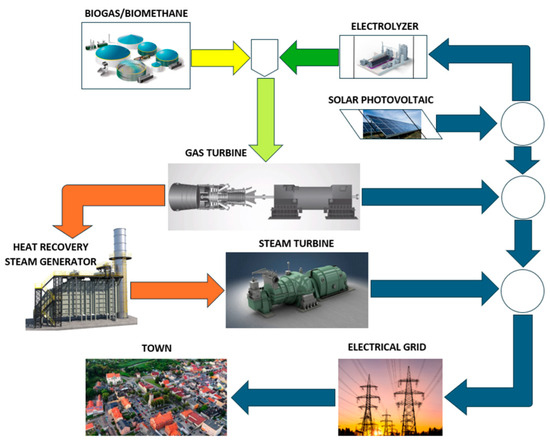
"Amid the growing global urgency to mitigate climate change and reduce dependence on fossil fuels, sustainable energy solutions have become increasingly critical. Biogas, a renewable mixture primarily composed of methane (CH4) and carbon dioxide (CO2), is widely utilized in the EU and beyond, offering substantial potential as a feedstock for green energy and chemical production. This study proposes novel process configurations for converting biogas into bio-methanol, offering a more efficient and environmentally favorable alternative to conventional biomethane production for grid injection. Two process scenarios were analyzed using rigorous simulation combined with exergy assessment. Scenario 1 involves direct steam methane reforming (SMR) of raw biogas followed by methanol synthesis, whereas Scenario 2 first removes CO2 to produce biomethane, which is subsequently reformed and converted to methanol. Both scenarios considered a biogas feed of 368 kg/h. Scenario 1 achieved a higher methanol yield (321.4 kg/h vs. 210.1 kg/h) but required greater steam input (551.8 kg/h vs. 195.4 kg/h) and produced more gas sent to the flare system (22.2 kg/h). Scenario 2 consumed less steam, generated lower flaring gas (1.2 kg/h), and achieved higher CO2 capture (132.4 kg/h vs. 237.7 kg/h), demonstrating its environmental advantage. The exergy efficiencies were calculated as 64.4 % for Scenario 1 and 60.9 % for Scenario 2. Overall, Scenario 1 is optimal for maximizing methanol production, while Scenario 2 better aligns with emission reduction goals. This comparative analysis elucidates the trade-offs between energy efficiency, production yield, and environmental impact in bio-based energy systems."
Sobre o artigo
The study evaluates biogas conversion into bio-methanol using two process configurations: direct steam methane reforming (SMR) and a CO₂ removal route followed by reforming.
Mahdi Enayati e Francesco Di Maria
Autor do artigo